


PANAMA
The Canal. The Coasts. The Country in Between.
Panama has a problem – in the best possible sense: once you look, you simply cannot stop. Between the Pacific to the south and the Caribbean to the north, on an isthmus that is barely 80 kilometres wide at its narrowest point, lies a country that holds far more than it promises at first glance. And right in the middle: one of the most astonishing feats of engineering in the world.
For travellers from Switzerland, Germany and Austria, Panama is often the unknown half of a Central American journey. They fly to San José, see Costa Rica – and have no idea what they’ve missed. This blog is here to change that.
The Panama Canal: More Than a Lock System
Seeing the Panama Canal for the first time, you’re surprised – not because it overwhelms, but because it is so quiet. A cargo ship longer than three football pitches moves through the locks at walking pace. The water rises. The chambers fill. And suddenly you understand what it means to connect two oceans.
The Miraflores Locks, just a few kilometres outside Panama City, are the classic visitor stop. The visitor centre is well done – interactive, multilingual, with a viewing deck from which you can watch ships pass through up close. But those who want to go deeper book a partial transit by boat: a few hours on the water, through locks and rainforest, with one of the world’s greatest logistical wonders as a backdrop.
What almost nobody knows: the canal does not run from east to west, but from north-west to south-east. Watching the sunrise on the Pacific side, you are looking east – and on the Caribbean side, west. It confuses. And it shows just how much this country can outwit its own geography.
Panama City: Modern and Colonial in One Breath
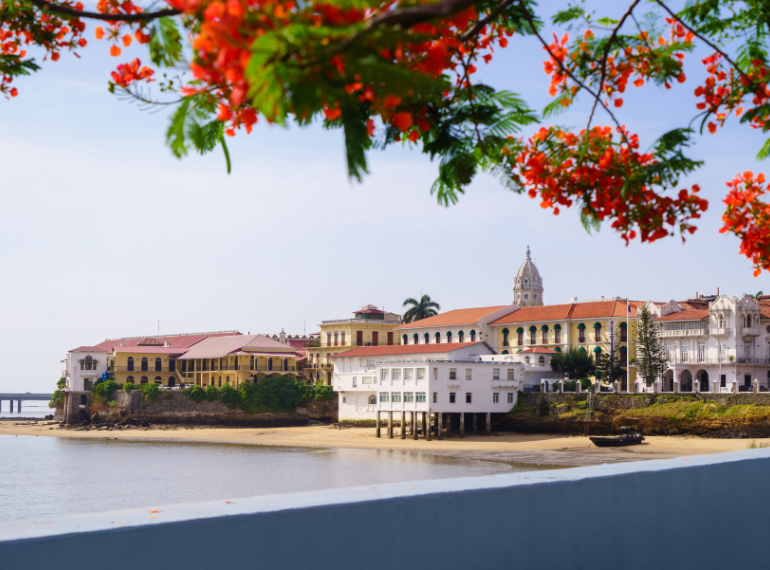
The capital is one of the few Latin American metropolises where futuristic glass facades and colonial history stand so close together. In the Casco Viejo – a UNESCO World Heritage site since 1997 – church ruins meet lovingly restored boutique hotels, art galleries sit beside small canteens. And from the rooftops a panorama unfolds that unites both: the winding lanes of the old town and the modern skyline gleaming over the bay in the evening light.
We include Panama City as a starting or ending point for a trip – with enough time to truly settle in. Two to three nights, a day trip to the canal, an evening in the Casco Viejo: that’s enough to see the best without rushing.
Bocas del Toro and San Blas: Two Ways of Experiencing the Caribbean
Panama has two Caribbean destinations that could not be more different – and both are extraordinary.
Bocas del Toro is colourful, lively, sometimes loud. An archipelago of nine larger islands, wooden houses on stilts above the water, surfers and snorkellers, reggae sounds drifting from open bars, and in between mangrove forests where sloths live. Bocas is a place you either love or find too busy – but the impression stays with you.
San Blas – officially the Comarca Guna Yala – is the opposite. 365 islands, white sand, turquoise water, and: no luxury resort, no chain hotel. The territory is managed by the indigenous Guna community, who decide who comes, where guests stay, and how tourism takes shape. The result is honest exchange rather than performance – and beaches that no glossy magazine in the world can quite capture.
The Panama–Costa Rica Combined Trip: Why It Makes Sense
Panama and Costa Rica share more than just a border. A similar climate, lush nature and warm hospitality. At the same time, the two countries complement each other perfectly. Costa Rica stands out for its established national parks, strong ecotourism infrastructure and easy accessibility. Panama captivates with its world-famous canal, indigenous islands and the urban energy of Panama City.
A combined circuit of two to three weeks linking both countries is ideal for travellers from Switzerland, Germany and Austria – especially since flight connections to both San José and Panama City are straightforward. At Swiss Tropical Tourism, we have been planning such combinations for years, know both countries well, and understand how to design an itinerary so that you neither rush nor miss too much of what’s beautiful.
Practical Information for Swiss, German and Austrian Travellers
Entry Requirements
No visa required for stays of up to 180 days. Passport must be valid for at least 6 months at the time of entry. Sufficient funds (USD 500 or proof of credit card) and proof of onward travel are required (e.g. return or onward flight ticket, or a confirmed onward bus/transfer ticket to another country).
Getting There
Tocumen International Airport (PTY) in Panama City is one of the largest hubs in Latin America. Direct flights from Europe via Air France (Paris), KLM (Amsterdam) or Iberia (Madrid). In combination with Costa Rica: fly into San José, return from Panama City (or vice versa).
Climate & Best Time to Travel
Panama has a tropical climate and can be visited year-round. Temperatures typically range from 29–32 °C, cooler at higher elevations and sometimes fresh at night. The dry season (peak travel season) runs from December to April. In the green season (rainy season), nature is particularly lush and waterfalls and rivers are impressive. Mornings are often sunny, with short, heavy showers later in the day; October and November tend to be the wettest months. Many hotels are also more affordable during the rainy season.
In general, the Pacific side is drier and slightly cooler than the Caribbean, where there are no clearly defined seasons. In July and August, the Pacific coast is often the better choice (also great for surfing).
Seasonal Highlights:
- July–October: whale watching on the Pacific coast (humpback whales)
- Pacific & Caribbean: sea turtle watching depending on region and season
- Coiba: top diving destination, particularly exciting in the green season
- Bocas del Toro: September/October and February/March are among the driest months; hurricanes are not expected during these periods.
Budget & Costs
Panama is generally less expensive than Costa Rica – especially in Panama City and for many excursions. Depending on your accommodation category, budget around CHF 80–150 per person per day. We recommend boutique hotels in the Casco Viejo, charming island lodges in Bocas del Toro, and simple, authentic community-style accommodation on San Blas – each unforgettable in its own way.
▸ FAQ
Q: Is Panama a suitable destination for Swiss, German, Austrian and other EU travellers?
A: Yes, Panama is straightforward for Swiss and EU citizens: no visa, stable currency (US dollar), good infrastructure. The country is considered one of the safest in Central America. Guided city tours with local guides and official taxis or pre-booked transfers are recommended.
Q: What is the difference between Bocas del Toro and San Blas?
A: Bocas del Toro is accessible, touristy, with a lively island atmosphere and surfing opportunities. San Blas (Guna Yala) is indigenous territory with stricter rules, more basic accommodation and unspoilt nature – but all the more authentic and memorable for culturally curious travellers.
Q: How can Panama best be combined with Costa Rica?
A: The classic combination: fly into San José (Costa Rica), circuit through Costa Rica (10–14 days), cross over or fly to Panama, Panama City with the canal and Casco Viejo (3–4 days), optionally Bocas del Toro or San Blas (3–4 days). Total duration: 18–22 days.
Q: Is a visit to the Panama Canal really worth it?
A: Yes – even for travellers who aren’t particularly interested in engineering. The Miraflores Locks are easily accessible and the visitor centre is informative. A partial transit by boat is the more impressive experience, but must be booked in advance.
Q: How does Swiss Tropical Tourism plan a Panama trip?
Comments are closed