


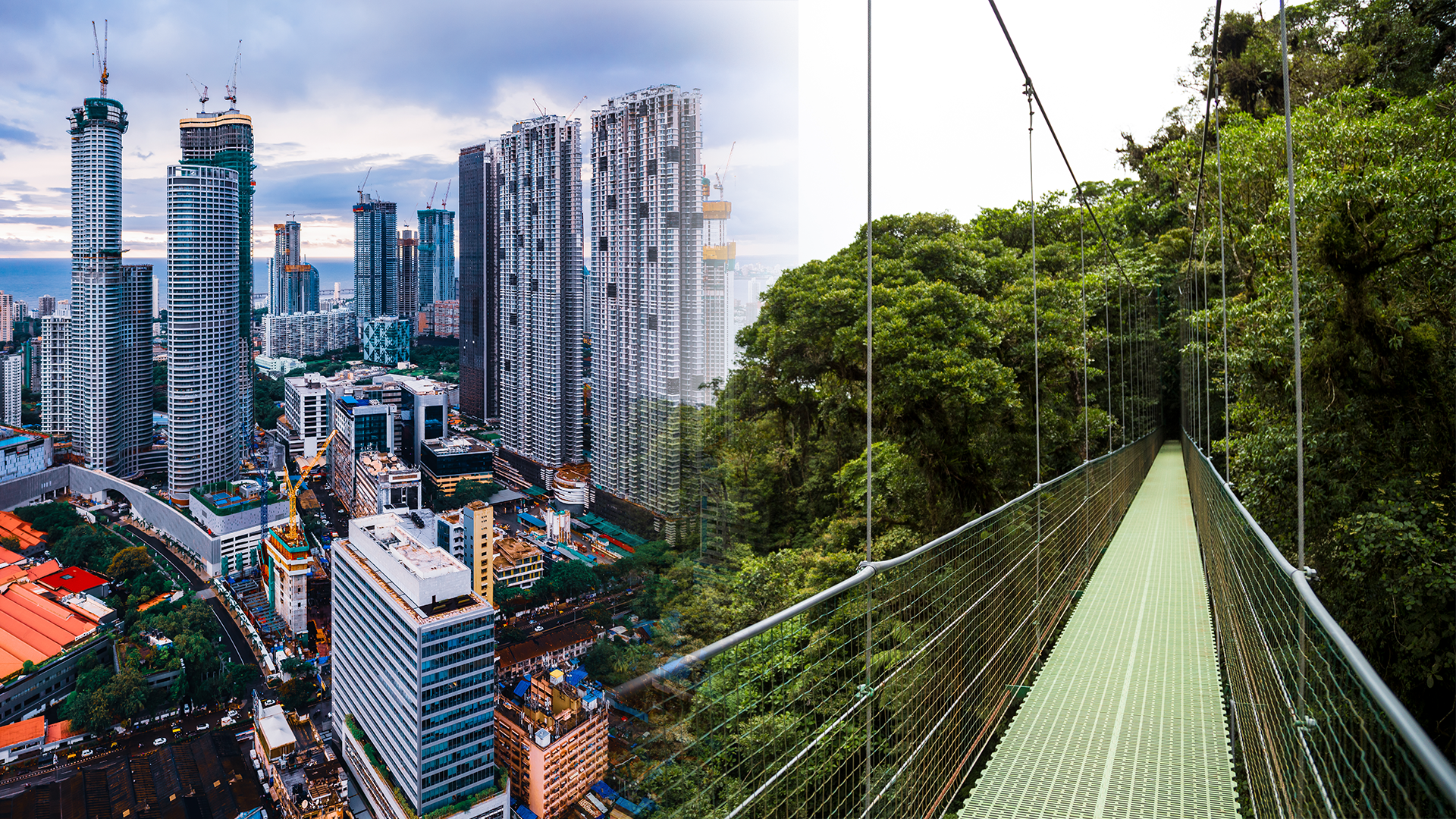
City Meets Jungle: The Perfect Panama–Costa Rica Combined Trip in Two Weeks
Trips that show only one side leave questions unanswered. Panama City alone would be an intense urban experience – but not a complete picture of Central America. Costa Rica alone would be pure nature – but no city, no history, no gastronomy to help you understand the region. Together, these two countries deliver a trip that answers both questions.
Panama City – Metropolis Between Two Oceans
Anyone seeing Panama City for the first time is surprised. The skyline rising at the Pacific entrance to the Canal is reminiscent of Miami or Singapore – not Central America. This city is a financial and logistics hub that has grown exponentially over a few decades, giving rise to a peculiar blend of old and new.
Casco Viejo: The Colonial Heart
The historic centre of Casco Viejo, a UNESCO World Heritage Site since 1997, is the complete opposite of the high-rise waterfront. Narrow lanes, restored colonial buildings in pastel colours, 17th-century churches beside modern bars and restaurants. The renovation wave of recent years has turned Casco Viejo into one of the most interesting city districts in Latin America.
The Panama Canal – More Than an Engineering Feat
The Panama Canal is not only logistically significant. It is the result of one of the greatest acts of human will in the 20th century – a project that cost tens of thousands of lives and rewrote the geography of global trade. The Miraflores Visitor Centre makes this context comprehensible and offers a four-storey terrace showing what happens when a freighter the size of a building is drawn through a lock.
Nature Near the City: Soberanía National Park
One of Panama City’s remarkable features is the Pipeline Road in Soberanía National Park – an unpaved road through the rainforest that borders the city directly. It is considered one of the finest birdwatching routes in the world: more than 500 bird species have been documented here. All of this just 20 minutes from the city centre.
| Tip: For travellers from Europe: Panama City needs at least three nights to combine both faces of the city – modern and colonial – as well as the Canal and a nature excursion. |
Onwards to Costa Rica
From Panama City to Costa Rica there are two sensible options: a domestic flight from Tocumen to San José (approximately 1 hour), or the overland route via the Paso Canoas border crossing. In most cases we recommend the flight and handle the complete transfer door to door.
Costa Rica: Volcano, Cloud Forest, Caribbean, Pacific
Arenal – Warmth and Power
Arenal volcano is the first great image of Costa Rica that stays with you. An almost perfectly symmetrical cone rising above the lake of the same name. The thermal springs at the volcano’s base emerge at the surface at around 40°C. After a day on the hanging bridges, that feels like a well-earned reward.
Monteverde – The Cloud Forest
Three hours from Arenal, along a mountain road, an entirely different ecosystem begins. In Monteverde, clouds hang in the forest. The humidity is so consistently high that mosses, orchids and ferns cover every surface. The zip-lining above the Monteverde canopy helped pioneer this form of active tourism.
The Caribbean Coast – A Different Costa Rica
Puerto Viejo de Talamanca is one of those places you visit and never quite leave behind. The Caribbean coast is culturally and atmospherically a complete contrast to the Pacific: Jamaican influences in the music and cuisine, a relaxed pace of life, coral worlds right off the coast.
Osa Peninsula or Manuel Antonio – The Finale
For the end of the trip there are two schools of thought: those who want maximum wilderness head to the Osa Peninsula with Corcovado. Those who want to combine beach, national park and convenience choose Manuel Antonio: a small, very lively national park right by the sea.
Why This Combination Works
Panama gives your trip urban depth: history, gastronomy, architecture and a geopolitical context that makes Central America comprehensible. Costa Rica gives it soul: pristine nature, biodiversity and the spirit of a country that abolished its army nearly 80 years ago.
FAQ
Do Swiss, British and US citizens need a visa for Panama and Costa Rica?
No. Neither country requires a visa for citizens of most Western nations. Stays of up to 90 days in Panama and 180 days in Costa Rica are visa-free. Your passport must be valid for at least 6 months beyond your travel dates.
When is the best time for this combined itinerary?
December to April is the dry season and optimal for both destinations. With the right planning, the rainy season (June–October) is also manageable.
How many days do you need for this route?
Ideally 14 to 16 days: 3–4 nights in Panama City, 10–12 days in Costa Rica. We always adapt the itinerary to the time available.
Can this route be done as a self-drive trip?
In Costa Rica, yes – and we actively recommend it. A rental car gives freedom and allows for spontaneous stops. In Panama City itself, public transport or taxis are more practical.
→ Plan your combined trip: dahlercostarica.com/tours/
Comments are closed