


The tiny guardians of the rainforest: why weprotect stingless bees in Costa Rica — andhow you can be part of it
Walk through the rainforest of Costa Rica and you hear it everywhere — a soft, constant
hum. You don’t always see who’s making it. Hidden in tree trunks, old clay jars, even
inside house walls: stingless bees. Tiny, silent, indispensable. And threatened. At Swiss
Tropical Tourism, we decided we couldn’t simply look the other way.
A bee without a sting — and still irreplaceable
It sounds almost like a paradox: a bee that can’t sting. But stingless bees — in Spanish «abejas
sin aguijón», scientifically the Meliponini — are neither harmless nor defenceless. They protect
themselves with resin, scent and speed. What they lack is a functional stinger. What they have
instead more than makes up for it.
Costa Rica is home to around 60 species of these bees — from the tiny Mariola (Tetragonisca
angustula) to larger species of the Melipona genus. They pollinate hundreds of tropical plant
species, including fruits, orchids and plants that are fundamental to the entire rainforest
ecosystem. Without them, a substantial part of Costa Rica’s biodiversity would simply cease to
exist.
And yet they are disappearing. Deforestation, pesticides, the loss of natural cavities — all of it is
shrinking their habitat. Faster than we’d like to believe.
Learn more about Meliponini bees in the Americas at: Aroma del Campo — Stingless Bee Blog
«A stingless bee pollinates plants that no other bee species can reach.
It’s not just another insect — it’s a keystone.»
— Aroma del Campo, Costa Rica
[INTERN: IMAGE 2 here — Colony box Aroma del Campo]
Aroma del Campo: a project with soul
This is where our partner comes in. Aroma del Campo, based in Costa Rica, specialises in
breeding, protecting and professionally installing stingless bee colonies — with an approach that
resonated with us at Swiss Tropical Tourism immediately: sustainability isn’t a marketing word.
It’s a decision you make every single day.
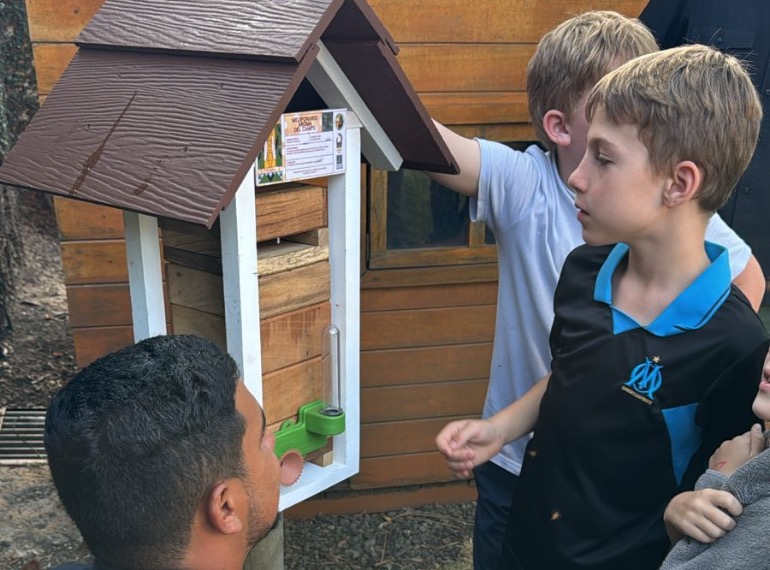
The Aroma del Campo team installs beehives in schools, hotels, companies and private
properties. Every project is professionally supported: from choosing the right species for each
location to ongoing colony care. At Caspari Montessori International School, a school yard was
transformed into a living outdoor classroom. At Hotel Borinquen Resort, a garden corner
became a self-sustaining ecosystem. Even Café Britt Costa Rica works with the team.
What impressed us most: the founders know what they’re talking about — not from textbooks,
but from years with their hands in the earth. They pass on this knowledge through hands-on
workshops and training sessions.
All Aroma del Campo projects and installations: aromadelcampocr.com/proyectos
Their products and beehive boxes: aromadelcampocr.com/productos
[INTERN: IMAGE 3 here — Project photo school or hotel]
Beyond visits: we help install new beehives
Swiss Tropical Tourism doesn’t just support Aroma del Campo by bringing our guests there. We
go further: working directly with the Aroma del Campo team, we help install new beehives —
small wooden boxes that give a colony of stingless bees a safe home — on our own fincas and
at partner properties across Costa Rica.
Every new beehive means a new colony that pollinates, strengthens the ecosystem, produces
honey and proves, tangibly, that tourism and nature conservation don’t cancel each other out.
They reinforce each other.
This isn’t sponsorship from a distance. It’s active, hands-on collaboration — with tools, effort and
the genuine desire that the Costa Rica our guests fall in love with still exists in twenty years. A
real partnership, in the spirit of how the Dähler family has lived in this country for decades.
«We don’t plant trees for photographs. We build beehives because we
live here — and because what we do today shapes the country of
tomorrow.»
— Dähler Family, Swiss Tropical Tourism
[INTERN: IMAGE 4 here — Beehive installation on Finca Dähler]
What does this have to do with your trip?
You might be wondering: that’s all well and good — but what does a stingless bee have to do
with my holiday in Costa Rica?
More than you’d think.
When you travel with Swiss Tropical Tourism, you don’t simply book transfers and hotels. You
travel into a country we know — from the inside, with roots in the soil of these fincas. Our
founding family, the Dählers, have lived here for decades, farming organic plantations of
pineapple, cacao and moringa, and they understand first-hand the tension between economic
progress and ecological responsibility.
And if you’d like: you can experience this project up close. We’re happy to include visits to
Meliponini projects in individual Costa Rica itineraries — for everyone who understands
ecotourism not as a buzzword, but as a genuine encounter.
Our Costa Rica tours: dahlercostarica.com/en/tours (internal link)
About the Dähler family: dahlercostarica.com/en/travel-agency (internal link)
Our organic finca — pineapple, cacao, moringa: dahlercostarica.com/en/pineapple-farm (internal
link)
«Sustainable travel doesn’t mean giving up comfort. It means knowing
what’s behind the experience — and choosing it anyway.»
— Dähler Family, Swiss Tropical Tourism
[INTERN: IMAGE 5 here — Honey or Cerumen close-up]
5 things to know about stingless bees in Costa Rica
Before we wrap up, five facts you won’t forget after reading this:
✔ Costa Rica is home to around 60 species of stingless bees — more than the total number
of bee species found in any single European country.
✔ The Mariola (Tetragonisca angustula) is the most common stingless species in Costa
Rica and is perfectly suited for gardens, schools and hotel projects.
✔ The honey of these bees — miel de abeja sin aguijón — is thinner, more acidic and more
aromatic than European honey. It has been used for centuries in indigenous medicine
across Central America.
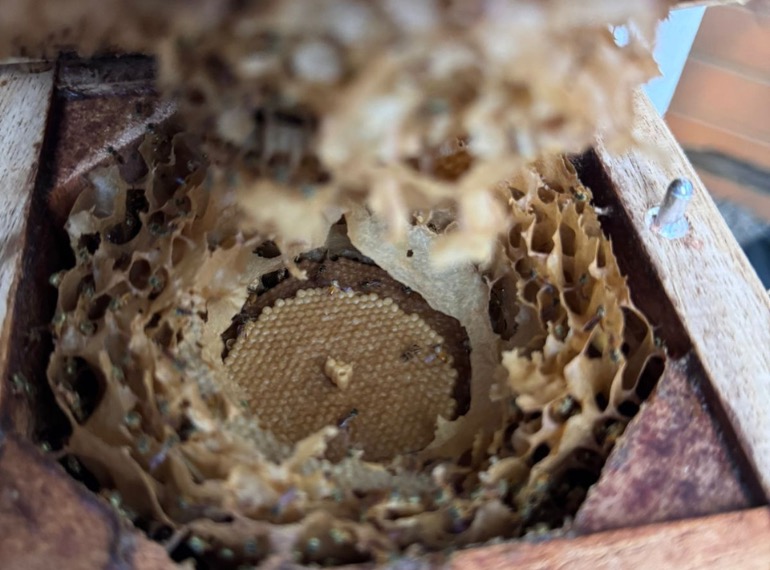
✔ Stingless bees build their hives from Cerumen — a blend of beeswax and plant resin that
protects the colony from fungi and parasites.
✔ Meliponicultura — the keeping of stingless bees — is one of the oldest agricultural
practices in Mesoamerica. The Maya kept them in hollowed-out logs long before Europe
knew the honeybee.
Full scientific background on the Meliponini: Stingless bees in the Americas — Aroma del
Campo
Want to take home more than a tan?
Then you’re in the right place. Swiss Tropical Tourism plans trips to Costa Rica that leave a
mark — not just in your photos, but in you. We show you a country we love. And we show you
how your trip can make a real difference.
Write to us. Tell us what you’re looking for. We’ll handle the rest — in English, German or
French.
Comments are closed